Theming
Prerequisites: Familiarity with Styling with Mix and Design Tokens.
Mix’s theming system uses design tokens — key-value pairs for colors, text styles, spacing, and border radii — to style your app consistently. Provide token values through MixScope, and all descendant widgets resolve those values at build time. Switch themes by swapping the token maps.
Getting Started
This tutorial builds a single-screen, multi-theme application. The final result looks like this:
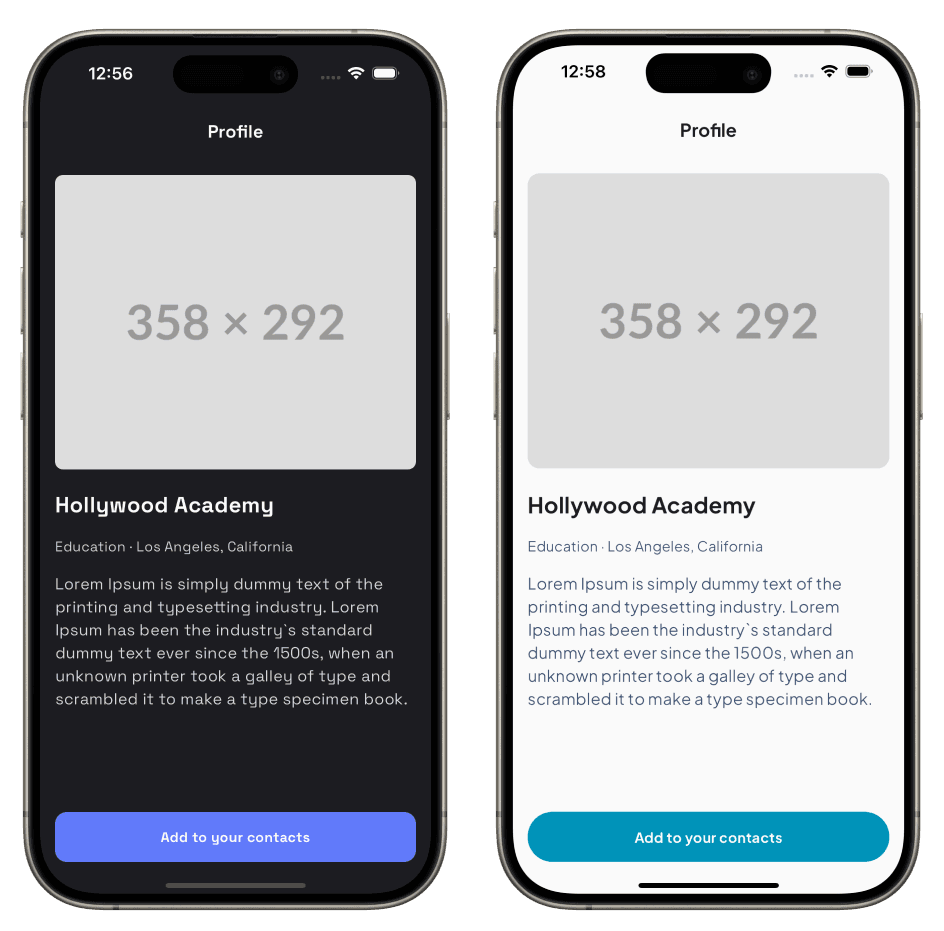
The image shows two themes for the same screen, each using distinct colors, text styles, fonts, and border radii. The left uses a light theme with blue as the primary color (LightBlueTheme). The right uses a dark theme with purple (DarkPurpleTheme).
Setting Up MixScope
MixScope provides token values to all descendant widgets. Wrap your root widget with MixScope and pass token value maps through named parameters.
Here’s how you can initialize and implement MixScope:
Wrapping the Root Widget
To apply your theme globally, you’ll want to wrap your application’s widgets with the MixScope widget, providing token values through named parameters.
class MyApp extends StatelessWidget {
  const MyApp({super.key});

  @override
  Widget build(BuildContext context) {
    return MixScope(
      colors: LightBlueTheme.colors,
      textStyles: LightBlueTheme.textStyles,
      radii: LightBlueTheme.radii,
      spaces: LightBlueTheme.spaces,
      child: const MaterialApp(
        home: ProfilePage(),
      ),
    );
  }
}
Creating Design Tokens
The next crucial step is defining your design tokens. In Mix, there are several types of design tokens: ColorToken, TextStyleToken, SpaceToken, RadiusToken, and BreakpointToken. Each token type represents a different design property.
The recommended way to organize your tokens is using Dart enums. This provides type safety, autocomplete support, and a clean API. Here’s how to define your token enums:
enum CustomColorTokens {
  primary('primary'),
  onPrimary('on-primary'),
  surface('surface'),
  onSurface('on-surface'),
  onSurfaceVariant('on-surface-variant');

  final String name;
  const CustomColorTokens(this.name);

  ColorToken get token => ColorToken(name);
}

enum CustomTextStyleTokens {
  headline1('headline1'),
  headline2('headline2'),
  button('button'),
  body('body'),
  callout('callout');

  final String name;
  const CustomTextStyleTokens(this.name);

  TextStyleToken get token => TextStyleToken(name);
}

enum MyThemeRadiusToken {
  large('large'),
  medium('medium');

  final String name;
  const MyThemeRadiusToken(this.name);

  RadiusToken get token => RadiusToken(name);
}

enum MyThemeSpaceToken {
  medium('medium'),
  large('large');

  final String name;
  const MyThemeSpaceToken(this.name);

  SpaceToken get token => SpaceToken(name);
}
With this approach, you access tokens like this:
final primaryColorToken = CustomColorTokens.primary.token;
final headline1TextStyleToken = CustomTextStyleTokens.headline1.token;
An alternative is to define tokens as top-level constants with the $ prefix convention (e.g., const $primary = ColorToken('primary')). Both approaches work — enums provide organization, while $ constants are more concise for inline usage.
Creating Theme Data
Now that we have our tokens defined, we need to create theme classes that map tokens to their actual values. We’ll organize these as static maps within theme classes. This makes it easy to switch between themes.
Here’s the LightBlueTheme:
class LightBlueTheme {
  static Map<ColorToken, Color> get colors => {
    CustomColorTokens.primary.token: const Color(0xFF0093B9),
    CustomColorTokens.onPrimary.token: const Color(0xFFFAFAFA),
    CustomColorTokens.surface.token: const Color(0xFFFAFAFA),
    CustomColorTokens.onSurface.token: const Color(0xFF141C24),
    CustomColorTokens.onSurfaceVariant.token: const Color(0xFF405473),
  };

  static Map<TextStyleToken, TextStyle> get textStyles => {
    CustomTextStyleTokens.headline1.token: const TextStyle(
      fontSize: 22,
      fontWeight: FontWeight.bold,
      fontFamily: 'Roboto',
    ),
    CustomTextStyleTokens.headline2.token: const TextStyle(
      fontSize: 18,
      fontWeight: FontWeight.bold,
      fontFamily: 'Roboto',
    ),
    CustomTextStyleTokens.button.token: const TextStyle(
      fontSize: 14,
      fontWeight: FontWeight.bold,
      fontFamily: 'Roboto',
    ),
    CustomTextStyleTokens.body.token: const TextStyle(
      fontSize: 16,
      fontWeight: FontWeight.normal,
      fontFamily: 'Roboto',
    ),
    CustomTextStyleTokens.callout.token: const TextStyle(
      fontSize: 14,
      fontWeight: FontWeight.normal,
      fontFamily: 'Roboto',
    ),
  };

  static Map<RadiusToken, Radius> get radii => {
    MyThemeRadiusToken.large.token: const Radius.circular(100),
    MyThemeRadiusToken.medium.token: const Radius.circular(12),
  };

  static Map<SpaceToken, double> get spaces => {
    MyThemeSpaceToken.medium.token: 16,
    MyThemeSpaceToken.large.token: 24,
  };
}
And the DarkPurpleTheme:
class DarkPurpleTheme {
  static Map<ColorToken, Color> get colors => {
    CustomColorTokens.primary.token: const Color(0xFF617AFA),
    CustomColorTokens.onPrimary.token: const Color(0xFFFAFAFA),
    CustomColorTokens.surface.token: const Color(0xFF1C1C21),
    CustomColorTokens.onSurface.token: const Color(0xFFFAFAFA),
    CustomColorTokens.onSurfaceVariant.token: const Color(0xFFD6D6DE),
  };

  static Map<TextStyleToken, TextStyle> get textStyles => {
    CustomTextStyleTokens.headline1.token: const TextStyle(
      fontSize: 22,
      fontWeight: FontWeight.bold,
      fontFamily: 'Courier',
    ),
    CustomTextStyleTokens.headline2.token: const TextStyle(
      fontSize: 18,
      fontWeight: FontWeight.bold,
      fontFamily: 'Courier',
    ),
    CustomTextStyleTokens.button.token: const TextStyle(
      fontSize: 14,
      fontWeight: FontWeight.bold,
      fontFamily: 'Courier',
    ),
    CustomTextStyleTokens.body.token: const TextStyle(
      fontSize: 16,
      fontWeight: FontWeight.normal,
      fontFamily: 'Courier',
    ),
    CustomTextStyleTokens.callout.token: const TextStyle(
      fontSize: 14,
      fontWeight: FontWeight.normal,
      fontFamily: 'Courier',
    ),
  };

  static Map<RadiusToken, Radius> get radii => {
    MyThemeRadiusToken.large.token: const Radius.circular(12),
    MyThemeRadiusToken.medium.token: const Radius.circular(8),
  };

  static Map<SpaceToken, double> get spaces => {
    MyThemeSpaceToken.medium.token: 16,
    MyThemeSpaceToken.large.token: 24,
  };
}
Creating the UI
Now that we have defined our themes, we can start creating the UI for our application. We will create a simple profile page with an image and some text, and then apply the themes to the UI.
Creating the Components
The interface chosen for this guide is quite simple. The only custom component is a button, so let’s create that first.
class ProfileButton extends StatelessWidget {
  const ProfileButton({super.key, required this.label});

  final String label;

  @override
  Widget build(BuildContext context) {
    // Create a box styler with tokens
    final box = BoxStyler()
        .height(50)
        .width(double.infinity)
        .color(CustomColorTokens.primary.token())
        .alignment(.center)
        .borderRadiusAll(MyThemeRadiusToken.large.token());

    // Create a text styler with tokens
    final text = TextStyler()
        .style(CustomTextStyleTokens.button.token.mix())
        .color(CustomColorTokens.onPrimary.token());

    // Use stylers as callable functions
    return box(child: text(label));
  }
}
This code demonstrates several key concepts:
- Token calling: Call tokens as functions with
token()to get token references that resolve at build time - TextStyle tokens: Use
.token.mix()forTextStyleTokento get a Mix-compatible reference for use with the.style()method. This is needed becauseTextStyleTokenresolves toTextStyle, which must be wrapped as aTextStyleMixfor the styling pipeline - Callable stylers: Mix stylers can be called like functions —
box(child: widget)is equivalent toBox(style: box, child: widget), andtext(label)is equivalent toStyledText(label, style: text) - Fluent API: Chain styling methods for clean, readable code
Creating the ProfilePage
Now that we have built the ProfileButton, we can create the ProfilePage widget. This page uses a combination of Mix widgets and Flutter’s native Scaffold.
class ProfilePage extends StatelessWidget {
  const ProfilePage({super.key});

  @override
  Widget build(BuildContext context) {
    // AppBar title styling
    final appBarTitle = TextStyler()
        .style(CustomTextStyleTokens.headline2.token.mix())
        .color(CustomColorTokens.onSurface.token());

    // Layout styling with FlexBoxStyler
    final flexBox = FlexBoxStyler()
        .crossAxisAlignment(.start)
        .marginAll(MyThemeSpaceToken.medium.token())
        .spacing(MyThemeSpaceToken.medium.token());

    return Scaffold(
      backgroundColor: CustomColorTokens.surface.token.resolve(context),
      appBar: AppBar(
        backgroundColor: CustomColorTokens.surface.token.resolve(context),
        title: appBarTitle('Profile'),
        centerTitle: false,
      ),
      body: SafeArea(
        child: ColumnBox(
          style: flexBox,
          children: [
            // Image placeholder
            ImagePlaceholder(),
            // Title
            StyledText(
              'Hollywood Academy',
              style: TextStyler()
                  .style(CustomTextStyleTokens.headline1.token.mix())
                  .color(CustomColorTokens.onSurface.token()),
            ),
            // Subtitle
            StyledText(
              'Education · Los Angeles, California',
              style: TextStyler()
                  .style(CustomTextStyleTokens.callout.token.mix())
                  .color(CustomColorTokens.onSurfaceVariant.token()),
            ),
            // Description
            StyledText(
              'Lorem Ipsum is simply dummy text of the printing and typesetting industry.',
              style: TextStyler()
                  .style(CustomTextStyleTokens.body.token.mix())
                  .color(CustomColorTokens.onSurfaceVariant.token()),
            ),
            const Spacer(),
            // Button
            const ProfileButton(label: 'Add to your contacts'),
          ],
        ),
      ),
    );
  }
}

class ImagePlaceholder extends StatelessWidget {
  const ImagePlaceholder({super.key});

  @override
  Widget build(BuildContext context) {
    final imageContainer = BoxStyler()
        .height(200)
        .width(double.infinity)
        .color(CustomColorTokens.primary.token())
        .borderRadiusAll(MyThemeRadiusToken.medium.token());

    final icon = IconStyler()
        .size(80)
        .color(CustomColorTokens.onPrimary.token());

    return imageContainer(child: icon(icon: Icons.image));
  }
}
Key points about this implementation:
- ColumnBox: Use Mix’s
ColumnBoxwithFlexBoxStylerfor layout control with token-based spacing - Token resolution: For native Flutter widgets like Scaffold and AppBar, use
.resolve(context)to get actual values - Callable stylers: Text stylers can be called as functions to create styled text widgets
- Component composition: Break down complex UIs into smaller, reusable components like
ImagePlaceholder
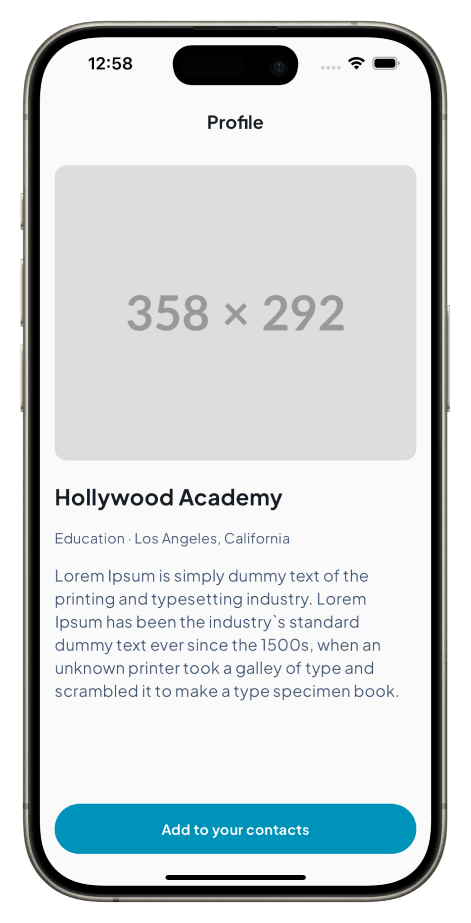
Now that everything is set up, you can wrap your app with MixScope to provide the theme values.
Switching Between Themes
One of the powerful features of Mix’s theming system is the ability to switch themes dynamically. Here’s how you can implement theme switching:
class ThemingTutorialApp extends StatefulWidget {
  const ThemingTutorialApp({super.key});

  @override
  State<ThemingTutorialApp> createState() => _ThemingTutorialAppState();
}

class _ThemingTutorialAppState extends State<ThemingTutorialApp> {
  bool _isDarkPurpleTheme = false;

  @override
  Widget build(BuildContext context) {
    // Select theme based on state
    final colors = _isDarkPurpleTheme
        ? DarkPurpleTheme.colors
        : LightBlueTheme.colors;
    final textStyles = _isDarkPurpleTheme
        ? DarkPurpleTheme.textStyles
        : LightBlueTheme.textStyles;
    final radii = _isDarkPurpleTheme
        ? DarkPurpleTheme.radii
        : LightBlueTheme.radii;
    final spaces = _isDarkPurpleTheme
        ? DarkPurpleTheme.spaces
        : LightBlueTheme.spaces;

    return MixScope(
      colors: colors,
      textStyles: textStyles,
      radii: radii,
      spaces: spaces,
      child: const MaterialApp(
        home: ProfilePage(),
      ),
    );
  }
}
To toggle the theme, simply call setState to update _isDarkPurpleTheme. All widgets using tokens will automatically update to reflect the new theme.
Key Takeaways
Mix’s theming system provides:
- Type-safe tokens: Enum-based tokens with compile-time safety and autocomplete support
- Easy theme switching: Change themes by updating token value maps
- Consistent styling: Tokens ensure design consistency across your entire app
- Fluent API: Chainable stylers with callable functions for clean code
- Flexible integration: Works seamlessly with both Mix widgets and native Flutter widgets
Best Practices
- Organize tokens by category: Use separate enums for colors, text styles, radii, and spacing
- Use static theme classes: Keep theme data organized in classes with static getters
- Leverage callable stylers: Use stylers as functions for concise component code
- Compose components: Break down UIs into smaller, reusable styled components
- Mix with Flutter: Use Mix for your design system components, native Flutter widgets where appropriate